




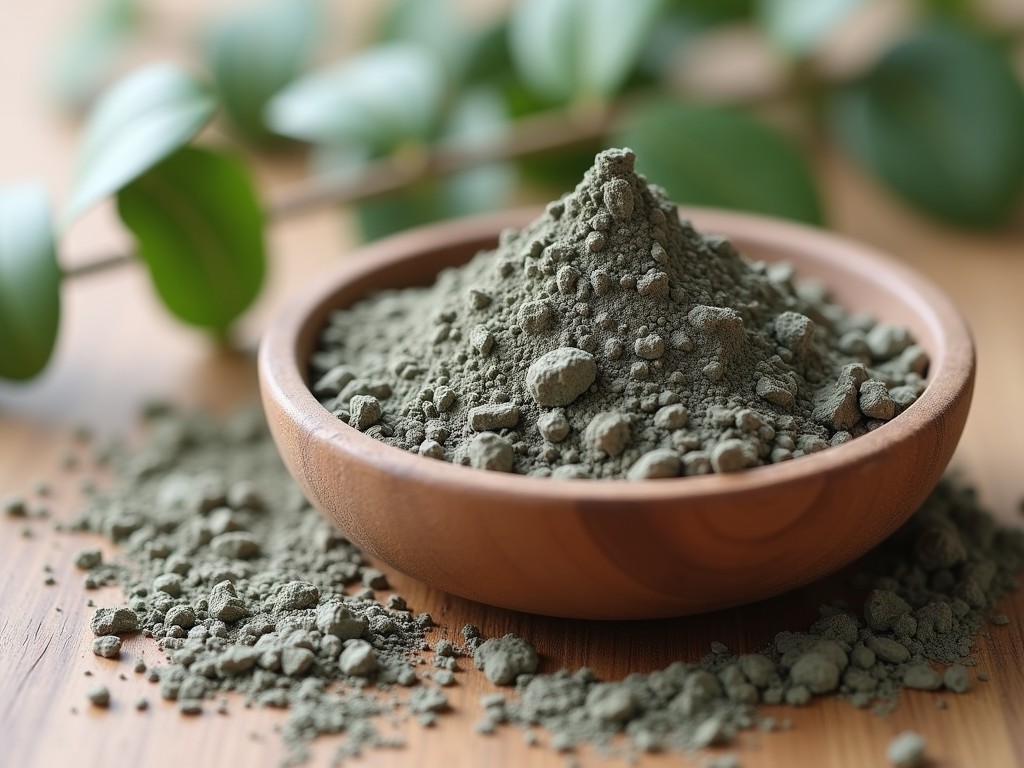
Buy Bentonite Clay Powder Benefits For Skin
Bentonite Clay Powder for Skin Care Applications
Bentonite is a naturally occurring aluminosilicate clay formed from the weathering of volcanic ash. Its dominant mineral is montmorillonite, a layered silicate with a high cation exchange capacity. The material is typically supplied as a fine powder after drying and milling to controlled particle specifications.
Typical Chemical Composition
The oxide composition of bentonite influences its reactivity and compatibility with aqueous systems. Values vary with source but fall within typical ranges for commercial grades.
| Component | Typical Range (wt%) |
|---|---|
| SiO₂ | 50 – 65 |
| Al₂O₃ | 15 – 25 |
| Fe₂O₃ | 2 – 8 |
| MgO | 1 – 5 |
| CaO | 0.5 – 3 |
| Na₂O | 0.2 – 2 |
| Loss on Ignition (LOI) | 8 – 15 |
Key Physical Parameters
Particle size, surface area, and swelling behavior determine how the clay feels on skin and its performance in formulations.
| Parameter | Typical Value | Test Method |
|---|---|---|
| D50 (median particle size) | 5 – 15 µm | Laser diffraction |
| Specific surface area (BET) | 50 – 120 m²/g | Gas adsorption |
| Swelling volume (in water, 24 h) | 8 – 12 mL/g | ASTM D422 |
| pH (10 % slurry) | 8.5 – 9.5 | Electrometric |
| Moisture content | ≤ 8 % | Thermo‑gravimetric |
How Bentonite Interacts with Skin Care Formulations
The high surface area and negative layer charge enable adsorption of polar impurities, excess sebum, and certain microbial metabolites. When dispersed in water, the clay swells, increasing viscosity and providing a suspending action for active ingredients.
In rinse‑off masks, the drying film creates a mild mechanical exfoliation as it cracks, facilitating removal of loosened debris. In leave‑on products, controlled amounts improve rheology without imparting a heavy feel.
- Facial masks – provides thickening, adsorption, and a cooling sensation upon drying
- Cleansers and scrubs – acts as a mild abrasive and stabilizes suspended particles
- Body wraps and poultices – retains moisture while delivering mineral contact to skin
- After‑sun gels – helps soothe by binding irritants and reducing surface temperature
Quality Assurance Practices
Each lot undergoes mineralogical verification by X‑ray diffraction to confirm montmorillonite content. Chemical purity is checked via inductively coupled plasma (ICP) for trace metals. Particle size distribution is measured using laser diffraction, and swelling capacity is assessed gravimetrically.
Typical specifications include: montmorillonite ≥ 70 %, lead ≤ 20 ppm, arsenic ≤ 5 ppm, and total aerobic microbial count ≤ 10³ CFU/g. Certificates of analysis are provided with every shipment.
Packaging Options and Shelf Life
The powder is packed in multi‑wall polyethylene bags with an inner moisture‑barrier liner, placed inside a corrugated carton. Standard net weights are 25 kg per bag, but custom sizes from 5 kg to 1 tonne are available upon request.
Storage in a dry, temperature‑controlled environment (below 30 °C, relative humidity < 60 %) prevents premature hydration and maintains flowability. Under these conditions the product retains its specified properties for at least 24 months from date of manufacture.