




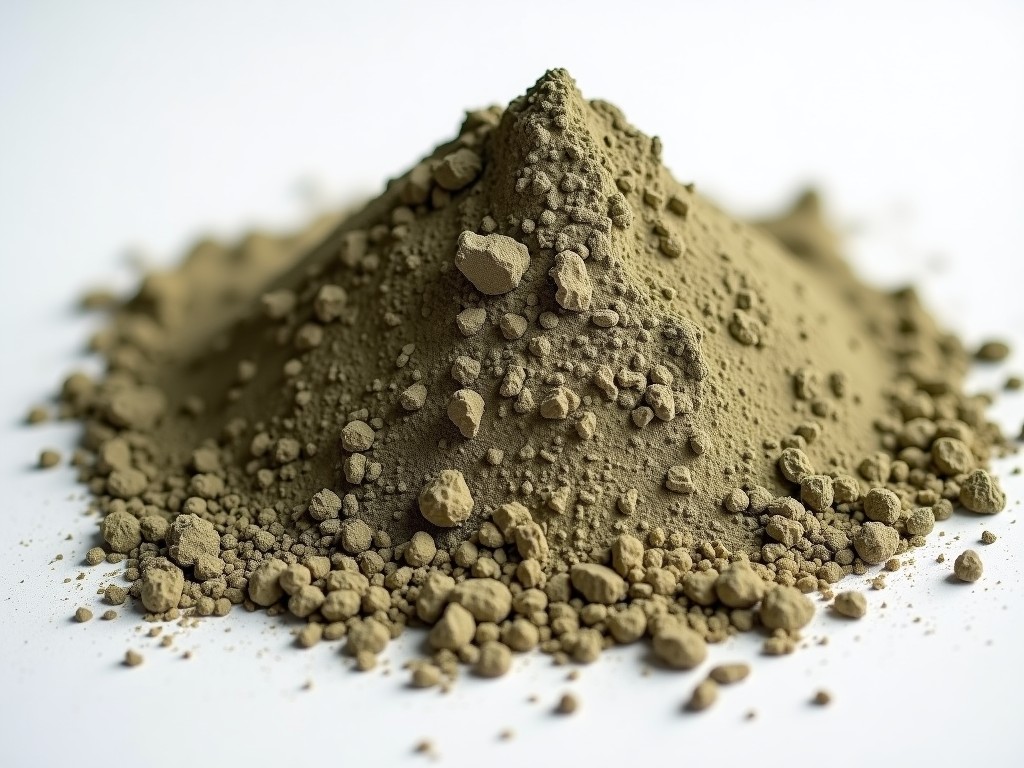
Oem Organic Bentonite Clay Powder
OEM Organic Bentonite Clay Powder
Organic bentonite clay powder originates from natural sodium bentonite that undergoes surface treatment with organic cations to render it organophilic.
In OEM supply chains, the material is delivered as a dry powder for incorporation into drilling fluids, foundry binders, and absorbent formulations where controlled swelling and selective adsorption are required.
Chemical Composition
The primary phase is montmorillonite, a 2:1 aluminosilicate with a typical SiO₂/Al₂O₃ weight ratio between 4.5 and 5.5.
Organic modification introduces quaternary ammonium surfactants, generally at a loading of 0.5 to 2.0 wt % relative to the dry clay, which shifts surface polarity toward hydrophobic interactions.
Physical Properties
Bulk density, measured after gentle tapping to avoid aeration, typically ranges from 0.55 to 0.70 g/cm³.
Particle size distribution is often controlled to a d₅₀ of 10–20 µm, with less than 5 % of particles exceeding 63 µm to ensure uniform dispersion in liquid systems.
Swelling capacity in deionized water reaches 12–18 g of water per gram of clay, whereas in organic solvents swelling is limited to 2–4 g/g, reflecting the organophilic nature.
| Property | Typical Range | Test Method |
|---|---|---|
| Bulk Density | 0.55–0.70 g/cm³ | ASTM D7263 |
| d₅₀ Particle Size | 10–20 µm | Laser Diffraction |
| Cation Exchange Capacity | 70–90 meq/100 g | Ammonium Acetate Method |
| Moisture Content (LOD) | ≤ 8 % | ASTM D2216 |
Typical Applications
In oil‑based drilling fluids, organophilic clay provides viscosification and suspension weighting while remaining compatible with hydrocarbon bases, which helps maintain wellbore stability under high temperature and pressure.
Foundries incorporate the powder as a binder additive in green sand molds; its organic coating enhances hot strength and reduces moisture‑related defects during metal pouring.
Environmental spill‑control formulations exploit the clay’s high affinity for non‑polar contaminants, enabling rapid uptake of oils and greases from water surfaces before they spread.
Processing and Handling
The product is hygroscopic; storage in sealed containers with desiccant limits moisture uptake that could alter rheological behavior.
Prior to incorporation, a pre‑wetting step with a polar activator such as methanol or ethanol (typically 5–10 % of clay weight) aids uniform dispersion of the organically modified layers.
Shear mixing at 500–1500 rpm for 2–5 minutes yields a stable dispersion, after which the formulation can proceed through standard milling or homogenization equipment.
Quality Control
Each batch is examined by X‑ray diffraction to confirm the montmorillonite (001) peak remains at 2θ ≈ 6.2°, indicating structural integrity after organic treatment.
Cation exchange capacity is measured via the ammonium acetate method; acceptable values for the organic variant fall between 70 and 90 meq/100 g.
Moisture content is determined by loss on drying at 105 °C; specifications usually limit it to ≤ 8 % to prevent clumping during storage.
Customization Options
- Particle size adjustment (d₅₀ from 5 µm to 40 µm) via jet milling or air classification.
- Organic surfactant loading tailored between 0.2 and 3.0 wt % for specific polarity requirements.
- Moisture content control through drying or conditioning to meet downstream processing limits.
- Surface treatment with alternative cationic agents (e.g., imidazolium, phosphonium) for niche compatibility.
Packaging Options
- Multi‑wall paper bags with inner polyethylene liner, 25 kg net weight.
- Bulk flexible intermediate bulk containers (IBCs), 500 kg or 1000 kg capacity.
- Returnable steel drums, 200 L, with corrosion‑resistant interior coating.
- Custom labeling and barcode integration available upon request.
FAQ
Q: Can the particle size be customized for specific formulation needs?
A: Yes, jet milling or air classification can adjust d₅₀ from 5 µm to 40 µm based on customer specifications.
Q: What information is required before a quotation can be issued?
A: Required details include target organic loading, desired particle size range, moisture content limit, order volume, and packaging preference.
Q: Which quality tests are performed on each batch?
A: Standard tests are X‑ray diffraction for phase identification, cation exchange capacity via ammonium acetate, loss on drying for moisture, and laser diffraction for particle size distribution.
Q: How are export shipments protected against moisture ingress?
A: Shipments use sealed inner liners within outer containers, accompanied by desiccant packs and humidity indicators to monitor transit conditions.
Q: What is the typical production lead time?
A: Lead time varies with order size and customization but generally ranges from 2 to 4 weeks after receipt of final specifications.
Contact our technical team to discuss specification requirements and request a sample.