




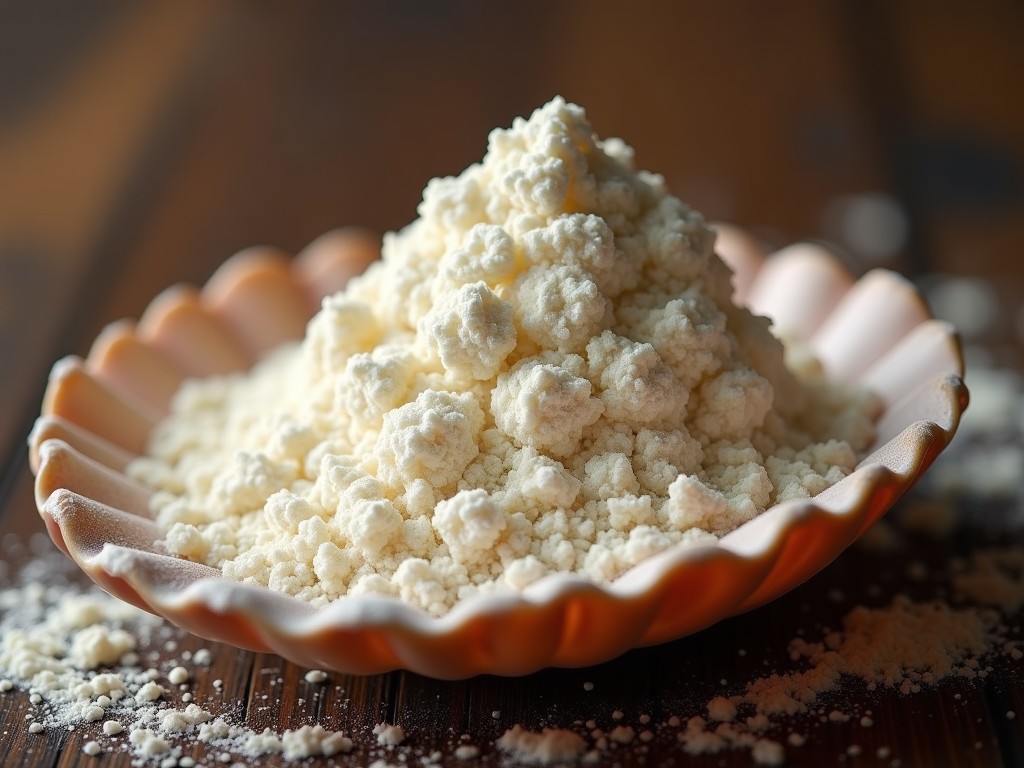
China Fossil Shell Flour
China Fossil Shell Flour
Fossil shell flour originates from the micronized calcareous shells of marine organisms deposited in sedimentary basins of northern China. The raw material undergoes controlled crushing, air classification, and heat treatment to achieve a consistent particle size range while preserving the inherent calcium carbonate structure.
The resulting powder is predominantly calcium carbonate (CaCO₃) with trace amounts of silica, magnesium carbonate, and organic residues. Typical chemical composition shows CaCO₃ content between 94% and 98%, loss on ignition below 2%, and acid-insoluble matter under 0.5%.
Physical Properties
Particle size distribution is a critical performance indicator. The flour is classified into three standard grades based on d₅₀ values: fine (5–10 µm), medium (15–25 µm), and coarse (30–50 µm). These ranges are achieved through precise air‑classifier settings and are verified by laser diffraction.
Specific gravity remains close to that of pure calcite, approximately 2.70 g/cm³, while bulk density varies from 0.45 g/cm³ for the fine grade to 0.55 g/cm³ for the coarse grade due to inter‑particle voidage. Moisture content is kept below 0.1% by storage in climate‑controlled silos.
The product exhibits a whiteness index (L*) typically above 90 when measured against a standard white tile, reflecting low impurity levels and effective surface cleaning during processing.
Typical Applications
- As a filler in polymer compounds, the flour improves stiffness and reduces shrinkage in PVC profiles and polypropylene injection‑molded parts.
- In rubber formulations, it acts as a reinforcing agent that enhances abrasion resistance while maintaining flexibility in conveyor belts and seals.
- The flour serves as a calcium source in agricultural feeds, providing a bioavailable mineral supplement for livestock and poultry.
- In construction materials, it contributes to the compressive strength of cementitious mortars and reduces permeability when used as a partial cement replacement.
- Environmental applications include its use as a neutralizing agent in acid‑mine drainage treatment due to its high calcium carbonate content and rapid dissolution rate.
Specification Table
| Property | Typical Value | Test Method |
|---|---|---|
| Calcium Carbonate (CaCO₃) % | 94 – 98 | ISO 12678 |
| Loss on Ignition (LOI) % | ≤ 2.0 | ASTM C25 |
| Acid‑Insoluble Matter % | ≤ 0.5 | ISO 9276‑1 |
| d₅₀ (Fine) µm | 5 – 10 | Laser Diffraction (ISO 13320) |
| d₅₀ (Medium) µm | 15 – 25 | Laser Diffraction (ISO 13320) |
| d₅₀ (Coarse) µm | 30 – 50 | Laser Diffraction (ISO 13320) |
| Specific Gravity g/cm³ | 2.68 – 2.72 | ASTM D854 |
| Whiteness Index L* | ≥ 90 | ISO 11664‑4 |
Quality Control Philosophy
Each production lot is sampled at three points: after crushing, after classification, and before packaging. Samples undergo chemical analysis for CaCO₃ content, loss on ignition, and impurity levels. Particle size is monitored continuously via inline laser diffraction with feedback to the classifier speed.
Statistical process control charts track key variables; any deviation beyond ±2σ triggers an automatic hold and root‑cause investigation. Final product is accompanied by a certificate of analysis that reports the average and range of each tested parameter for the specific batch.
Packaging Options
- Multi‑wall paper bags with inner polyethylene liner, net weight 25 kg, suitable for palletized transport.
- Flexible intermediate bulk containers (FIBCs) of 500 kg capacity, equipped with discharge spout and UV‑stabilized fabric.
- Bulk pneumatic tanker delivery for silo filling, with moisture‑proof lining and nitrogen purge option.
All packages are labeled with batch number, production date, grade specification, and handling instructions. Desiccant packs are included in bagged units to maintain moisture below 0.1% during transit.
Frequently Asked Questions
Yes. The air‑classification system allows adjustment of cut points to produce finer or coarser fractions subject to equipment limits. Custom d₅₀ values require a feasibility review and may affect yield.
Required details include desired grade (or target d₅₀), estimated annual quantity, preferred packaging type, and destination port for freight calculation. Providing the intended application helps the technical team suggest any necessary pretreatment.
Each batch undergoes full chemical and physical testing as outlined in the specification table. A representative sample is retained for third‑party verification if requested by the buyer.
Standard grades typically ship within 10–15 working days after order confirmation. Custom size grades may extend lead time to 20–25 working days due to classifier reprogramming and trial runs.
For technical data sheets, sample requests, or to discuss specific project requirements, please contact our sales engineering team.
Submit Inquiry