




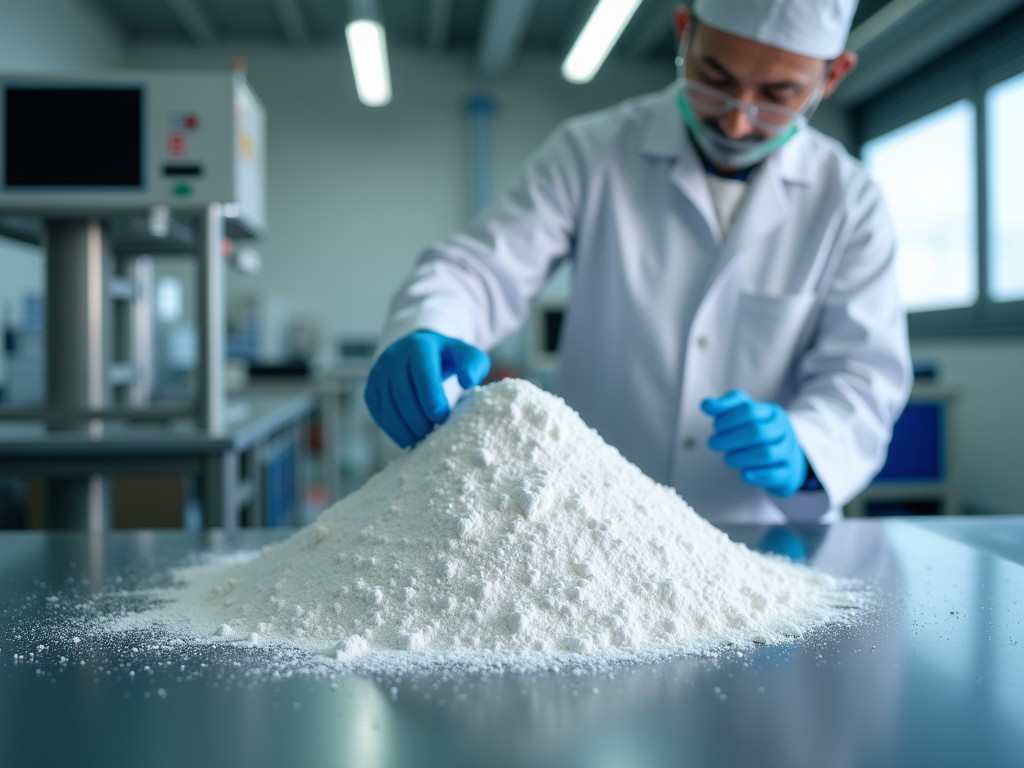
Diatomaceous Earth Food Grade Exporter Factory
Diatomaceous Earth Food Grade – Exporter Factory Overview
Product Characteristics
The material consists of fossilized silica shells of diatoms, primarily amorphous silicon dioxide with trace oxides. Typical food‑grade grades show a silicon dioxide content of 88 %–94 % by weight, iron oxide below 0.5 %, and aluminum oxide under 0.3 %. Loss on ignition after heating to 1000 °C is usually less than 6 %, indicating low organic residue. Bulk density ranges from 0.30 to 0.45 g/cm³ depending on particle size distribution, while the median particle size (D50) can be tailored between 5 µm and 45 µm to suit specific functional needs.
Manufacturing Process
Raw diatomite is extracted from selected quarries with low contaminant profiles, then crushed and milled to achieve the desired fineness. A controlled calcination step at 800 °C–1000 °C removes volatile organics and stabilizes the silica structure without converting it to crystalline quartz. Subsequent air classification separates fractions, and a final sieving stage ensures compliance with food‑grade particle‑size specifications. Throughout the line, magnetic separators and electrostatic filters reduce metallic impurities to <10 ppm.
Technical Specifications
| Property | Typical Value | Test Method |
|---|---|---|
| Silicon Dioxide (SiO₂) | 88 %–94 % | X‑ray fluorescence (XRF) |
| Iron Oxide (Fe₂O₃) | ≤0.5 % | XRF |
| Aluminum Oxide (Al₂O₃) | ≤0.3 % | XRF |
| Loss on Ignition (LOI) | ≤6 % | Thermogravimetric analysis (TGA) at 1000 °C |
| Bulk Density | 0.30–0.45 g/cm³ | ASTM C29 |
| Median Particle Size (D50) | 5–45 µm (customizable) | Laser diffraction |
| pH (10 % slurry) | 7.0–8.5 | ASTM D1293 |
| Moisture Content | ≤0.5 % | Karl Fischer titration |
Applications in Food Industry
As an anti‑caking agent, the porous particles absorb surface moisture on powders such as spices, baking mixes, and powdered beverages, preventing agglomeration during storage. Its high surface area also makes it an effective carrier for flavors, vitamins, and probiotics, allowing uniform dispersion without altering taste. In liquid filtration, diatomaceous earth forms a permeable cake that traps fine particulates while maintaining flow rates, which is valuable for clarifying juices, wines, and edible oils. The material’s inertness and compliance with FDA 21 CFR 182.10 ensure it does not introduce contaminants or affect product safety.
Quality Control & Compliance
Each batch undergoes a multi‑point testing protocol: chemical composition via XRF, particle size distribution by laser diffraction, moisture by Karl Fischer, and heavy‑metal screening (lead, cadmium, mercury, arsenic) to meet limits below 0.1 ppm. Facilities maintain ISO 22000 certification for food‑safe manufacturing and follow HACCP principles to identify and control potential hazards. Documentation includes a Certificate of Analysis (CoA) and, upon request, a Safety Data Sheet (SDS) that conforms to GHS standards.
Packaging & Export Logistics
Product is packed in multi‑wall polyethylene‑lined kraft bags (25 kg net) or, for bulk shipments, in food‑grade flexible intermediate bulk containers (FIBCs) with inner liners that provide moisture barrier protection. Palletized loads are stretch‑wrapped and secured with corner boards to prevent shifting during transit. Export documentation includes phytosanitary certificates, origin declarations, and, when required, FDA prior notice filings. Lead time from order confirmation to vessel loading typically ranges from 10 to 18 working days, depending on destination and customs clearance.
Customization Options
- Particle‑size grading: fine (5‑15 µm), medium (15‑30 µm), coarse (30‑45 µm) or bespoke cuts.
- Bulk density adjustment through controlled milling and air‑classification.
- Private labeling: custom bag prints, logo placement, and bilingual language packs.
- Additive blending: anti‑static agents or food‑grade flow enhancers upon request.
- Packaging sizes: 5 kg, 10 kg, 20 kg bags or 500 kg/1000 kg FIBCs.
Frequently Asked Questions
Can dimensions be customized? Yes, particle size distribution and bulk density are adjustable according to the end‑use requirements; specify target D50 and density when requesting a quote.
What information is required before quotation? Provide intended application, desired particle size range, quantity, packaging preference, and destination port to enable accurate pricing and lead‑time estimation.
What materials are available? We supply amorphous food‑grade diatomaceous earth; crystalline silica‑free grades are standard, with low‑iron and low‑aluminum options available.
How is quality inspected? Every lot receives XRF composition analysis, laser diffraction sizing, moisture testing, and heavy‑metal screening; results are documented in the CoA.
What packaging methods are available? Multi‑wall kraft bags with PE liner, food‑grade FIBCs, and custom‑printed options; all include moisture‑barrier protection.
How are export shipments protected? Palletized, stretch‑wrapped, corner‑boarded, and shipped in dry containers; optional desiccant packs can be added for high‑humidity routes.
What is the typical production lead time? From order confirmation to vessel loading: 10‑18 working days, subject to final testing and documentation.
How are samples arranged? Free 500 g samples can be dispatched via express courier; request sample through the contact form below.
Contact for Inquiry
To obtain a formal quotation, request a sample, or discuss technical details, please reach out to our export team. We will respond with a detailed specification sheet, pricing, and estimated delivery schedule within one business day.
Request Quotation or Sample