




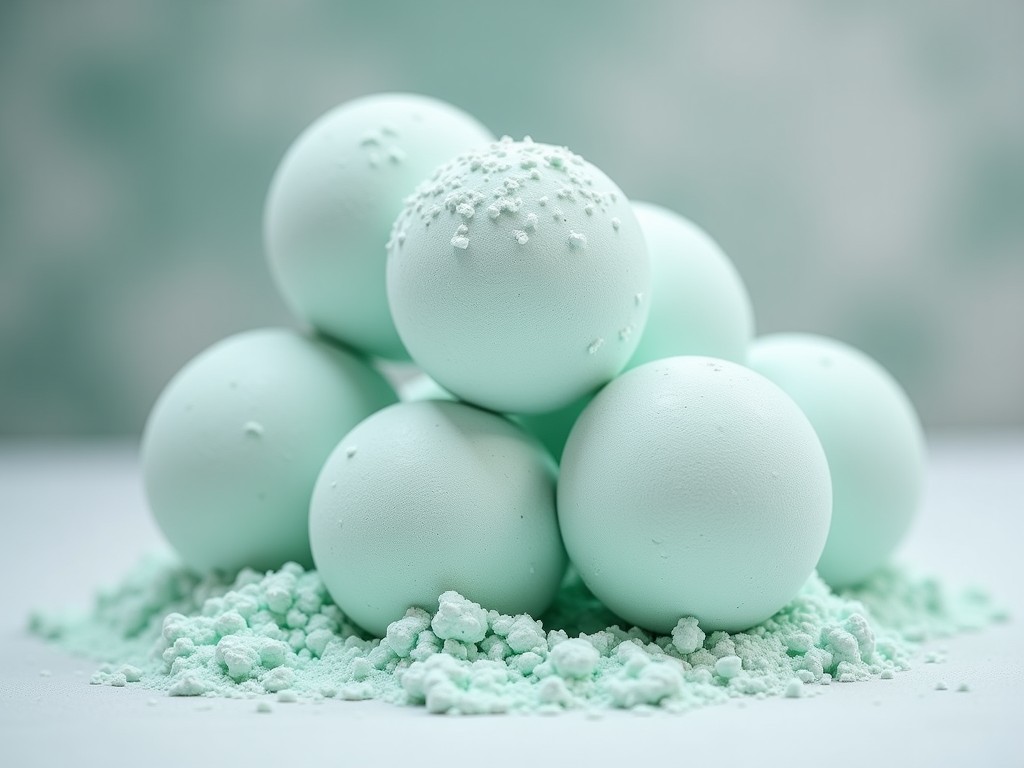
Benefits Of Kaolin Clay In Bath Bombs
Benefits of Kaolin Clay in Bath Bombs
Kaolin clay, a naturally occurring aluminum silicate mineral, is frequently used as a functional additive in bath bomb formulations. Its inclusion influences product performance, sensory attributes, and manufacturing stability.
Chemical and Mineralogical Composition
The primary constituent is kaolinite (Al₂Si₂O₅(OH)₄), typically comprising 90‑95 % of the material. Minor amounts of quartz, feldspar, and mica may be present depending on the deposit and processing.
Physical Properties Relevant to Bath Bomb Formulation
Key parameters that affect bath bomb behavior include particle size distribution, bulk density, moisture content, and pH of an aqueous slurry.
- Median particle size (D50) usually ranges from 2 µm to 6 µm for grades suitable as fillers.
- Bulk density falls between 0.45 g/cm³ and 0.55 g/cm³, influencing flowability during blending.
- Typical moisture content is below 0.5 % (w/w) after drying, minimizing premature reaction with acid‑base systems.
- A 10 % w/w slurry exhibits a pH of approximately 5.5‑6.5, which is mildly acidic and compatible with citric acid‑sodium bicarbonate effervescence.
Functional Benefits in Bath Bombs
When incorporated at typical levels of 5‑15 % (w/w) of the dry blend, kaolin clay provides several measurable advantages:
- Acts as an inert filler that reduces the overall cost per batch without compromising structural integrity.
- Modulates the rate of carbon dioxide generation by slightly diluting the reactive solids, leading to a smoother, longer‑lasting fizz.
- Imparts a silky, non‑gritty skin feel after dissolution, improving user perception of mildness.
- Helps absorb excess moisture during storage, thereby enhancing shelf‑life stability of the bath bomb.
- Contributes to opacity and a matte visual appearance, which can be desirable for certain product designs.
Formulation Considerations
Successful integration requires attention to mixing order, particle size compatibility, and moisture control. The clay should be dry‑blended with the sodium bicarbonate and citric acid before any liquid fragrance or oil is added to prevent premature activation.
If a wet granulation step is employed, the amount of binder (e.g., water or alcohol) must be adjusted because kaolin clay adsorbs liquid, increasing the effective viscosity of the mass.
Quality Control and Specification
Suppliers typically provide a certificate of analysis covering the following parameters. Values are indicative and can be adjusted according to project requirements.
Typical Property Table
| Property | Typical Value | Unit | Test Method |
|---|---|---|---|
| Loss on Ignition (LOI) | 12‑14 | % | ASTM C25 |
| Specific Gravity | 2.60‑2.65 | g/cm³ | ASTM D854 |
| Median Particle Size (D50) | 3‑5 | µm | Laser Diffraction |
| pH (10 % slurry) | 5.5‑6.5 | – | ASTM D1293 |
| Whiteness (ISO Brightness) | 80‑85 | % | ISO 2470 |
| Moisture Content | <0.5 | % (w/w) | ASTM D2216 |
Applications Beyond Bath Bombs
While this page focuses on bath bomb utility, the same kaolin grades are employed in pressed powders, facial masks, and as a rheology modifier in topical gels, demonstrating broad compatibility with personal‑care systems.
Frequently Asked Questions
Q: Can the particle size be customized for specific fizz profiles?
A: Yes, suppliers can offer milled or air‑classified fractions ranging from 1 µm to 10 µm D50 to tailor dissolution rate and skin feel.
Q: What information is required before a quotation is issued?
A: Required data include target usage level, desired particle size range, moisture specification, and any regulatory compliance needs (e.g., COSMOS, Ecocert).
Q: Which grades are commonly available for cosmetic use?
A: Cosmetic‑grade kaolin is typically low‑iron, high‑brightness, and tested for heavy‑metal limits per USP or EU CosIng guidelines.
Q: How is quality inspected for bulk shipments?
A: Standard practice involves lot‑based sampling for LOS, particle size, pH, and microbiological limits, with results provided in a certificate of analysis.
For technical datasheets, sample requests, or to discuss formulation adjustments, please contact our technical support team.
Request Information or Sample