




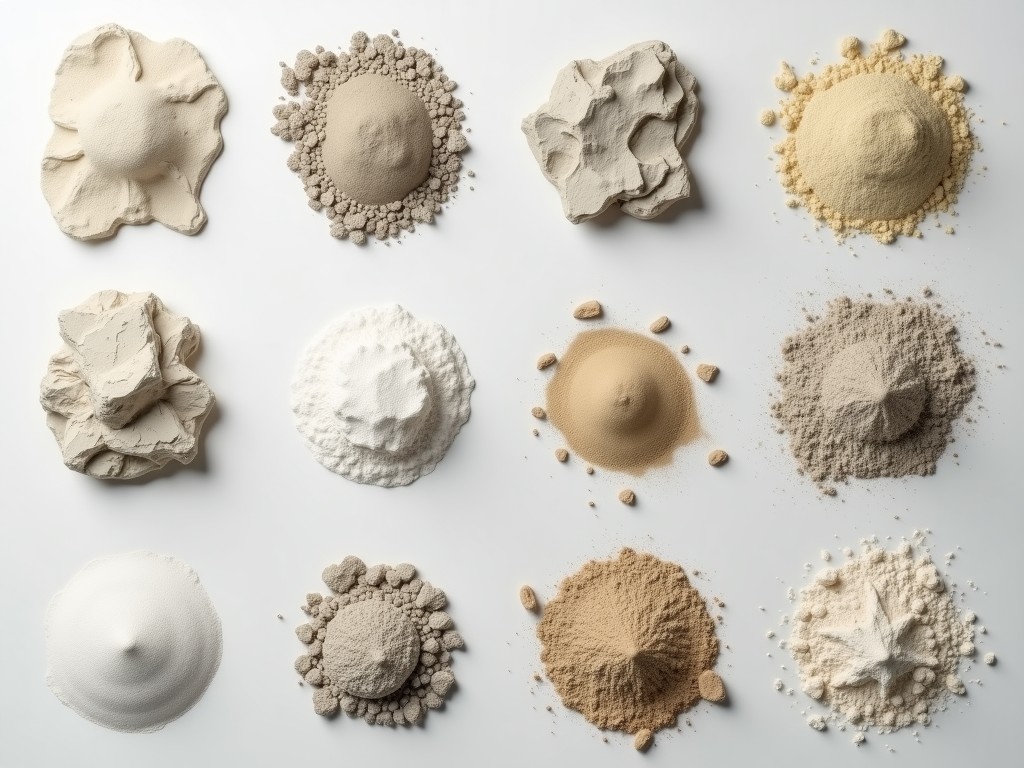
Different Types Of Kaolin Clay
Different Types of Kaolin Clay
Kaolin clay, also known as china clay, is a naturally occurring hydrous aluminum silicate mineral primarily composed of kaolinite. Its industrial value stems from attributes such as particle size distribution, brightness, abrasiveness, and chemical inertness, which vary with geological origin and post‑mining processing.
Understanding the distinctions among the various types enables engineers and procurement specialists to match material characteristics to specific performance requirements, reducing trial‑and‑error and improving product consistency.
Classification by Origin and Processing
Primary Kaolin
Primary kaolin is extracted from deposits where the mineral has undergone minimal transportation and retains the original crystallinity of the parent rock. Typical properties include a median particle size (d50) of 2–5 µm, ISO brightness ranging from 85 to 92 %, and a loss on ignition (LOI) below 12 %. The low impurity content makes it suitable for high‑gloss paper coating and fine porcelain.
Secondary Kaolin
Secondary kaolin has been transported by water or wind, resulting in finer particle size and higher levels of associated minerals such as quartz, feldspar, or iron oxides. Commonly observed d50 values fall between 0.5 and 2 µm, brightness may drop to 78–85 %, and LOI can rise to 14–16 % due to increased moisture and organic matter. These characteristics favor applications in rubber reinforcement and cementitious mixes where higher surface area improves interaction with polymers.
Calcined Kaolin
Calcination transforms hydrous kaolinite into metakaolin by heating the clay to temperatures between 650 °C and 900 °C, driving off chemically bound water. The resulting product exhibits an LOI near zero, increased surface area (typically 10–20 m²/g), and improved pozzolanic reactivity. Brightness after calcination often exceeds 90 % due to removal of color‑causing impurities, making it valuable in PVC cable insulation, adhesives, and as a catalyst support.
| Property | Primary Kaolin | Secondary Kaolin | Calcined Kaolin |
|---|---|---|---|
| Median particle size (d50) | 2–5 µm | 0.5–2 µm | 1–3 µm (after milling) |
| ISO brightness (%) | 85–92 | 78–85 | 90–96 |
| Loss on ignition (LOI, %) | <12 | 14–16 | <0.5 |
| Specific surface area (BET, m²/g) | 5–10 | 10–18 | 10–20 |
| pH (10% slurry) | 4.5–5.5 | 4.0–5.0 | 5.0–6.0 |
Key Properties Influencing Selection
Selection hinges on measurable attributes that directly affect end‑product performance. Below are the most frequently evaluated parameters and the typical range observed across kaolin types.
- Particle size distribution (d10, d50, d90) influences opacity, gloss, and reinforcement efficiency.
- ISO brightness determines visual appeal in coatings, papers, and plastics.
- Abrasiveness, often expressed as Mohs hardness (~2–2.5) or wear‑rate in polymer compounds, affects equipment life and filler‑induced wear.
- Loss on ignition indicates retained water and volatiles, impacting drying energy and final product density.
- Chemical purity, especially low iron oxide (<0.5 %) and titanium dioxide (<0.1 %), is critical for color‑sensitive applications.
- Cation exchange capacity (CEC) governs interaction with polymeric matrices and influences adsorption in catalytic processes.
- Rheological behavior, measured as viscosity at 100 s⁻¹ shear, dictates pumpability and settling stability in suspensions.
Industrial Applications and Rationale
In paper coating, primary kaolin’s high brightness and controlled particle size deliver superior gloss and ink hold‑out, while its low abrasiveness reduces blade wear on coating machines.
For ceramic bodies and glazes, secondary kaolin’s finer particle size increases green strength and promotes uniform sintering, whereas its slightly higher LOI contributes to necessary shrinkage during firing.
Calcined kaolin’s pozzolanic reactivity and near‑zero LOI make it an effective additive in cementitious mixtures, where it reacts with calcium hydroxide to form additional C‑S‑H gel, improving compressive strength and reducing permeability.
In PVC and polyolefin compounds, the increased surface area of calcined kaolin enhances polymer‑filler adhesion, leading to higher tensile strength and improved flame retardancy when combined with additives.
Rubber formulations benefit from secondary kaolin’s reinforced surface area, which improves stress distribution and abrasion resistance in tread compounds, while maintaining low hysteresis for fuel‑efficient tires.
Paint and ink manufacturers select primary kaolin for its ability to stabilize pigment dispersion and provide a matte to satin finish without altering color hue, thanks to its low iron content.
Catalyst supports often use calcined kaolin because the thermal treatment creates a stable, porous aluminosilicate framework that can accommodate active metal species without sintering at reaction temperatures.
Selection Considerations for Buyers
Buyers should align specification limits with processing constraints and end‑use performance targets. Key points to verify before quotation include:
- Required brightness range
- Acceptable particle size (d50) and distribution
- Maximum allowable LOI
- Impurity thresholds (Fe2O3, TiO2)
- Desired surface area or reactivity (especially for calcined grades)
- Preferred moisture content for handling
- Compatibility with existing equipment (abrasiveness tolerance)
- Regulatory or food‑grade certifications if applicable
Quality Control and Testing
Consistent quality is maintained through standardized test methods such as ISO 12457 for particle size analysis, ISO 11475 for brightness, and ASTM C311 for pozzolanic activity of calcined kaolin. Each batch is accompanied by a certificate of analysis reporting the measured values against the agreed specification.