




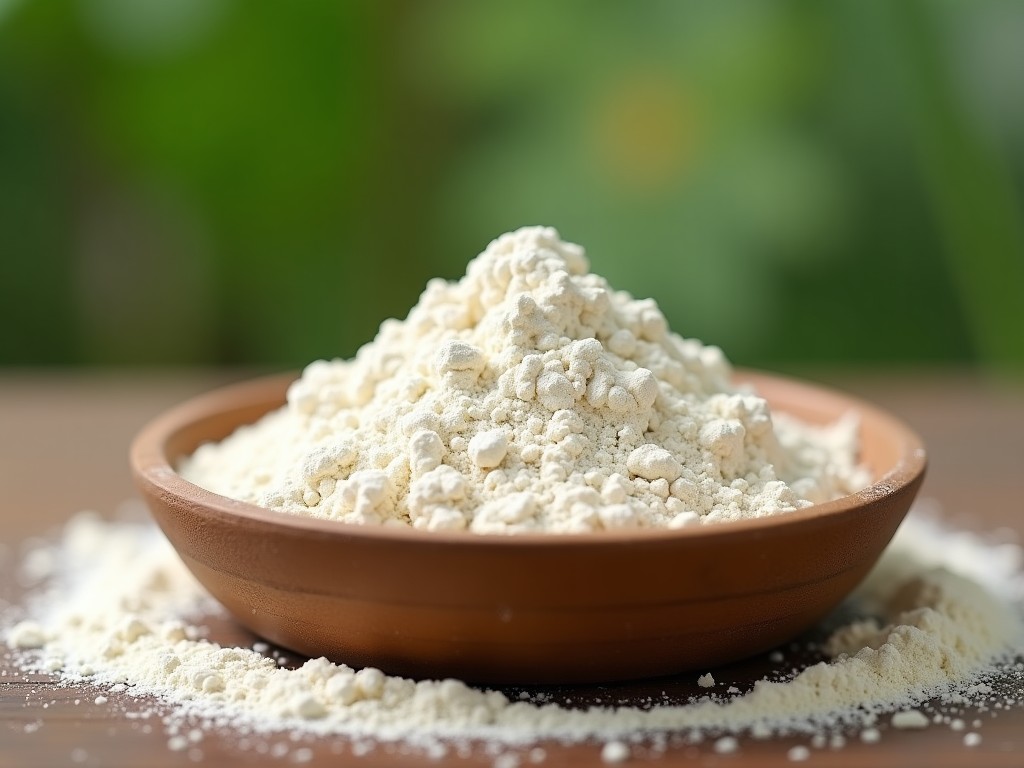
Kaolin Clay Powder For Agriculture Plants
Kaolin Clay Powder for Agriculture Plants
Kaolin, a naturally occurring hydrous aluminum silicate, is mined and processed into a fine powder for use in agricultural systems. Its mineralogical stability and controlled particle size enable specific interactions with soil, plant surfaces, and agrochemical formulations.
Chemical Composition
The primary constituents are alumina (Al₂O₃) and silica (SiO₂), typically present in a weight ratio of approximately 1:2. Trace amounts of iron oxide, titanium dioxide, and potassium oxide may vary depending on the deposit and processing grade.
Physical Properties
- Particle size distribution (laser diffraction): D10 1–2 µm, D50 2–6 µm, D90 10–20 µm.
- Specific surface area (BET): 5–12 m²/g.
- Bulk density: 0.4–0.6 g/cm³ (loose), 0.8–1.0 g/cm³ (tapped).
- pH of a 10% slurry: 4.5–5.5.
- Loss on ignition (LOI, 1000 °C): 12–14 wt%.
Function in Agricultural Systems
When incorporated into soil, kaolin particles act as inert fillers that modify porosity and water retention. Their platy morphology creates a micro‑scale framework that can reduce compaction while maintaining aeration. In foliar applications, the powder forms a semi‑permeable film that reflects excess solar radiation and provides a physical barrier against certain insects and pathogens.
Typical Applications
- Soil amendment to improve cation exchange capacity and buffer pH in acidic substrates.
- Carrier for bio‑pesticides and beneficial microbes, enhancing adhesion to leaf surfaces.
- Seed coating agent to improve flowability and provide a protective layer during germination.
- Component of anti‑transpirant sprays that reduce water loss under high temperature stress.
- Filler in granular fertilizer formulations to control granule size and dust generation.
Quality Control & Testing
Each batch undergoes routine verification using X‑ray fluorescence (XRF) for chemical composition, laser diffraction for particle size, and gravimetric methods for moisture and LOI. Results are compared against internal specifications to ensure consistency for agricultural performance.
Specification Table
| Parameter | Typical Range | Test Method |
|---|---|---|
| Al₂O₃ content | 35–38 wt% | XRF |
| SiO₂ content | 55–58 wt% | XRF |
| D50 particle size | 2–6 µm | Laser diffraction |
| Bulk density (tapped) | 0.8–1.0 g/cm³ | ASTM D7481 |
| pH (10% slurry) | 4.5–5.5 | Electrometric |
| Loss on ignition (1000 °C) | 12–14 wt% | Thermogravimetric |
Frequently Asked Questions
Can the particle size be customized for specific formulations?
Yes, milling and classification can be adjusted to achieve target D50 values between 1 µm and 15 µm, depending on the end‑use requirement.
What information is needed to obtain a quotation?
Required details include desired quantity, packaging size (e.g., 25 kg bags, bulk silo), target chemical specifications, and any required certifications (e.g., REACH, ISO 9001).
How is product purity verified?
Purity is assessed by XRF for major oxides and by LOI for volatile content; certificates of analysis are provided with each shipment.
What packaging options are available for agricultural distributors?
Standard offerings are multi‑wall paper bags with polyethylene liner (25 kg) and flexible intermediate bulk containers (FIBCs) of 500 kg or 1000 kg. Custom labeling can be arranged.
What is the typical lead time for a standard order?
Lead times range from 2 to 4 weeks for stocked grades; custom grades or large volumes may require 6 to 8 weeks, subject to production scheduling.
Get in Touch
For technical data sheets, sample requests, or to discuss formulation support, please contact our sales team.
Request a Quote