




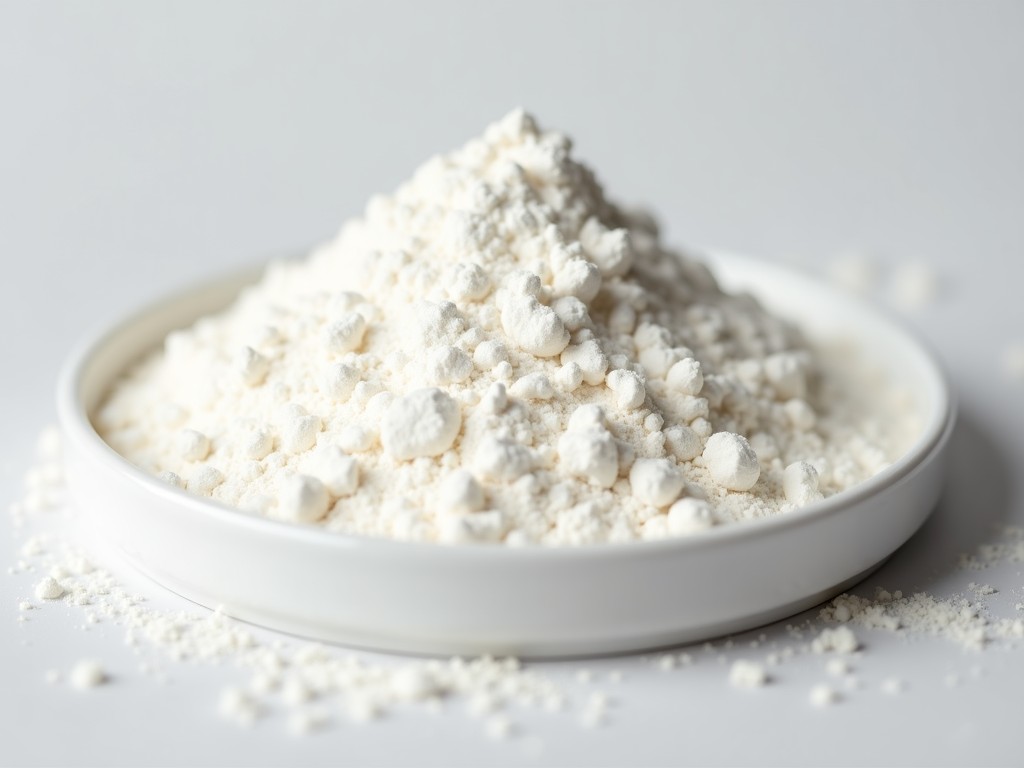
Oem White Kaolin Clay Powder
OEM White Kaolin Clay Powder
White kaolin clay, also known as china clay, is a naturally occurring hydrous aluminum silicate mineral primarily composed of kaolinite. It is valued for its fine particle size, high brightness, and chemical inertness, making it a functional filler and extender in numerous industrial formulations.
Typical Technical Characteristics
The performance of kaolin powder depends on measurable attributes that can be tailored to specific process requirements. Below are common ranges for untreated, water‑washed grades; values can be adjusted through classification or surface treatment.
| Property | Typical Range | Test Method |
|---|---|---|
| Particle size (d50) | 1.5 – 4.5 µm | Laser diffraction |
| Brightness (ISO) | 85 – 93 % | ISO 2470 |
| pH (10 % slurry) | 4.5 – 5.5 | ASTM D1208 |
| Loss on ignition (LOI) | 12 – 14 % | ASTM D373 |
| Specific surface area (BET) | 8 – 15 m²/g | BET nitrogen adsorption |
| Oil absorption (linseed) | 30 – 45 g/100 g | ASTM D281 |
Manufacturing Considerations
Raw kaolin is extracted from open‑pit mines and undergoes wet processing to remove impurities such as quartz, feldspar, and iron oxides. The slurry is degritted, centrifuged, and filtered before being dried in rotary or flash dryers. Final particle size distribution is achieved through air classification or hydraulic separation, allowing precise targeting of d50 values for downstream applications.
For applications requiring enhanced hydrophobicity or improved polymer compatibility, surface modification with silanes, fatty acids, or zirconium compounds can be performed after drying. These treatments alter the surface energy without affecting the intrinsic kaolinite crystal structure.
Primary Industrial Applications
Kaolin’s utility stems from its combination of fine size, platy morphology, and chemical stability. In paper coating, it provides gloss and ink hold‑out while reducing binder demand. In thermoplastics, the high aspect ratio particles improve stiffness and dimensional stability at low loading levels. Paints and coatings benefit from its opacity and ability to suspend pigments, extending titanium dioxide usage. In ceramics, kaolin contributes to green strength and controls shrinkage during firing. Rubber compounds use kaolin as a reinforcing filler that enhances tear resistance and reduces compound cost.
- Paper coating and filling – brightness, abrasion resistance
- Polypropylene and PVC compounds – flexural modulus, impact strength
- Architectural and industrial paints – hide, viscosity control
- Sanitaryware and tile bodies – casting rate, fired color
- Natural rubber and EPDM – reinforcement, processing aid
Customization Options
OEM suppliers can adjust several parameters to meet specific formulation or processing needs. Customization is typically discussed during the quotation phase, where particle size, moisture content, and surface chemistry are defined based on the customer’s technical data sheet.
- Particle size grades – coarse (d50 ≈ 10 µm) for rubber, fine (d50 ≈ 2 µm) for paper
- Moisture content – dry (<0.5 %) or conditioned (2‑5 %) for specific mixing equipment
- Surface treatments – silane, zirconate, fatty acid, or phosphate modifiers
- Packaging – multi‑wall paper bags, valve sacks, bulk totes, or pneumatic tanker
- Additives – anti‑caking agents, dispersants, or flow aids
Quality Control & Testing
Consistent product performance relies on rigorous monitoring at each stage. Incoming raw material is assayed for major oxides via X‑ray fluorescence to detect deviations in iron or titanium that could affect brightness. After processing, each batch undergoes laser diffraction for particle size distribution, spectrophotometric brightness measurement, and loss on ignition testing. Results are recorded against internal specifications and made available to customers upon request.
Statistical process control charts track key variables such as d50, pH, and moisture. Any drift triggers investigation of mill classifier settings, dryer temperature, or washing efficiency. This approach minimizes lot‑to‑lot variation and supports reliable supply for continuous production lines.
Packaging, Storage, and Handling
To preserve product integrity, kaolin is packaged in moisture‑barrier bags that prevent humidity uptake and contamination. Typical options include 25 kg multi‑wall paper bags with an inner polyethylene liner, 500 kg valve sacks, or 1200 kg bulk bags equipped with discharge spouts. For large‑volume users, pneumatic tanker delivery directly to silos is available.
Storage should be in a dry, covered environment with temperature fluctuations kept below ±10 °C to avoid condensation. Under these conditions, the product maintains its specified brightness and particle size for at least 24 months. Handling recommendations emphasize using dust‑control equipment, as fine powders can become airborne during transfer.
Frequently Asked Questions
- Can the particle size distribution be customized? Yes, classification equipment allows selection of specific d50 ranges; custom grades are quoted based on required specifications.
- What information is needed before a quotation? Application details, target loading level, desired brightness or color, moisture tolerance, and any surface treatment preferences help define the appropriate grade.
- How is quality verified for each batch? Each lot is tested for particle size (laser diffraction), brightness (ISO), pH, loss on ignition, and surface chemistry if treated; certificates of analysis are provided.
- What packaging options exist for export? Standard export‑ready packaging includes moisture‑barrier bags on pallets, stretch‑wrapped, and ISPM‑15 compliant wooden pallets; alternative bulk containers are available upon request.
Contact for Technical Support
For detailed data sheets, sample requests, or to discuss specific formulation challenges, please reach out to our technical team.
Request Technical Specification Sheet