




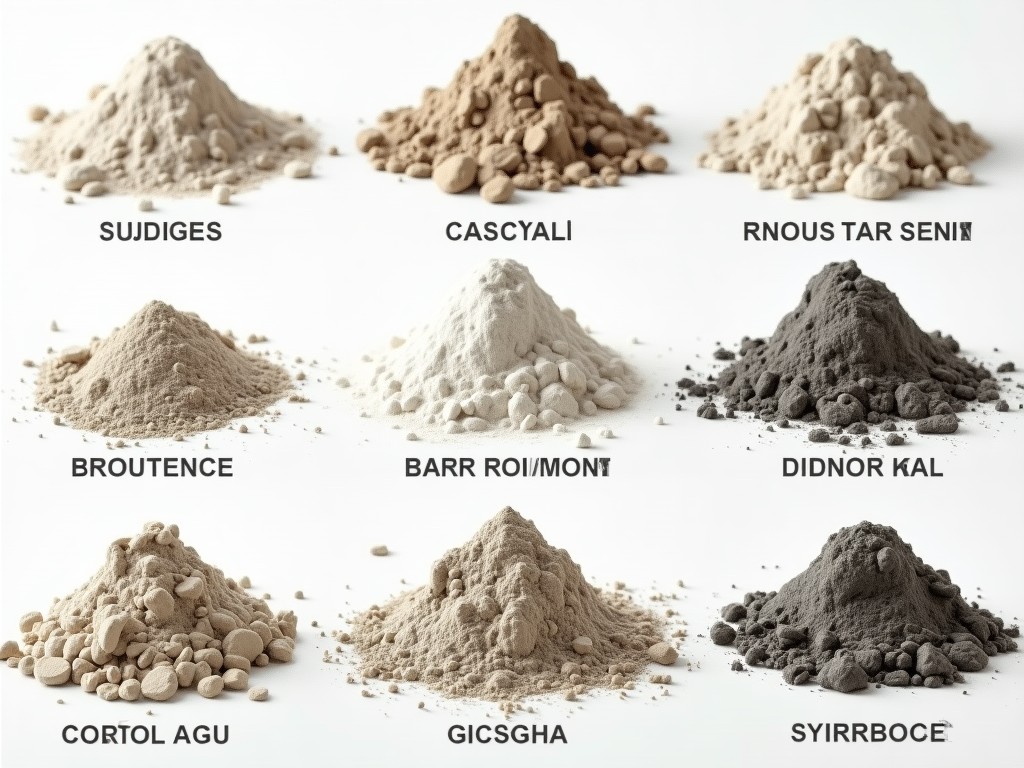
Types Of Kaolin Clay
Types of Kaolin Clay
Overview of Kaolin Clay
Kaolin clay, also known as china clay, is a soft white mineral composed primarily of the kaolinite Al₂Si₂O₅(OH)₄. Its low iron content gives it a high reflectance in the visible spectrum, which is quantified as brightness. The mineral occurs in sedimentary deposits where weathering of feldspar‑rich rocks has produced fine‑grained platelets.
Classification by Processing Method
Commercial kaolin is grouped according to the treatment it receives after mining. The three main categories are water‑washed, air‑float, and calcined grades. Each category exhibits distinct particle‑size distributions and surface chemistries that dictate suitability for specific processes.
- Water‑washed kaolin – slurry is pumped through centrifuges and hydrocyclones to remove grit and coarse particles, yielding a product with a median diameter (D50) typically between 1.5 µm and 3.0 µm.
- Air‑float kaolin – the dried slurry is milled and separated by air classifiers, producing a finer D50 often below 1.0 µm and a narrower size distribution.
- Calcined kaolin – water‑washed or air‑float material is heated to 650 °C–900 °C, driving off hydroxyl water and converting kaolinite to metakaolin, which increases specific surface area and reduces shrinkage in refractory applications.
Typical Property Ranges
The following table lists representative values for each processing type. Actual figures vary with deposit geology and plant conditions; suppliers provide certified data sheets for each lot.
| Property | Water‑washed | Air‑float | Calcined |
|---|---|---|---|
| D50 (µm) | 1.5 – 3.0 | 0.6 – 1.2 | 0.8 – 2.0 (after milling) |
| Brightness (% ISO) | 80 – 88 | 85 – 92 | 70 – 78 (post‑calcine) |
| pH (10% slurry) | 4.5 – 5.5 | 4.5 – 5.5 | 4.0 – 5.0 |
| Loss on ignition (%, 1000 °C) | 12 – 14 | 12 – 14 | 0.5 – 1.5 |
Industrial Applications and Rationale
In paper coating, water‑washed kaolin provides opacity and gloss while maintaining low abrasivity, which extends blade life. The brightness range of 80‑88 % ISO yields sufficient whiteness for high‑grade coated sheets without excessive titanium dioxide.
For porcelain and sanitaryware, air‑float kaolin’s sub‑micron particle size improves green strength and reduces drying shrinkage, leading to fewer cracks during bisque firing. Its low iron content (<0.2 % Fe₂O₃) minimizes color defects in the final glaze.
Calcined kaolin is used as a pozzolanic additive in concrete. The metakaolin formed reacts with calcium hydroxide to produce additional C‑S‑H gel, increasing compressive strength by 10‑20 % at 28 days when dosed at 5‑10 % by weight of cement.
In rubber compounding, kaolin acts as a reinforcing filler. The platelet morphology improves tensile strength and tear resistance, while the relatively low surface area (compared to silica) yields lower hysteresis, beneficial for rolling resistance in tire treads.
Selection Criteria for Buyers
When evaluating a kaolin supplier, request the following data points: particle‑size distribution (laser diffraction), brightness (ISO 2470), pH, loss on ignition, and chemical analysis (especially Fe₂O₃ and TiO₂). Compare these to the requirements of your process; for example, a paper coating line may specify D50 < 2 µm and brightness > 85 % ISO.
Consider the logistics of moisture content. Water‑washed grades are typically shipped at 12‑15 % moisture; air‑float products are often dried to < 5 % to prevent agglomeration. Calcined material is supplied dry and may require re‑hydration if used in slurry‑based applications.
Lead time and lot consistency are also critical. Ask for a statistical process control (SPC) report showing batch‑to‑batch variation in D50 and brightness; a coefficient of variation below 3 % indicates stable production.
Quality Control and Testing
Producers typically employ a combination of laser diffraction, X‑ray fluorescence (XRF), and spectrophotometers to monitor key parameters. Samples are taken at the dryer exit, after milling, and prior to packaging. Each lot receives a test certificate that includes:
- Median particle size (D50) and spread (D10–D90)
- Brightness (ISO 2470) and yellowness index
- Loss on ignition at 1000 °C
- Chemical composition (SiO₂, Al₂O₃, Fe₂O₃, TiO₂)
These data allow the buyer to verify that the material meets the specification sheet before it enters the production line.
Frequently Asked Questions
Can particle size be customized?
Yes. By adjusting classifier speed, feed rate, or using additional milling steps, suppliers can target D50 values from 0.4 µm to 5 µm. Custom gradients are available upon request and are validated with laser diffraction reports.
What information is needed for a quotation?
Provide the intended application, required brightness range, maximum allowable iron content, desired moisture level, and estimated annual volume. Including any regulatory standards (e.g., FDA, ASTM) helps the supplier quote the appropriate grade.
How is export shipment protected against moisture?
Water‑washed and air‑float grades are packed in multi‑wall polyethylene bags with inner liners, then placed on pallets and stretch‑wrapped. Calcined kaolin is shipped in moisture‑barrier bulk bags or silo trucks equipped with desiccant packs to maintain < 0.5 % moisture during transit.
Next Steps
To obtain a detailed datasheet or discuss a specific grade for your process, please use the contact form below. Provide your technical requirements and expected quantity; a materials engineer will respond with available options and lead times.
Request Information